
FRoST Heads Back to Mars With EROS at European Rover Challenge 2026
FRoST Heads Back to Mars With EROS
Frankfurt – August 21, 2026. The Martian surface is artificial and the mission fictional, but the competition is real: a student team from Frankfurt University of Applied Sciences (Frankfurt UAS) has once again qualified for the European Rover Challenge (ERC).
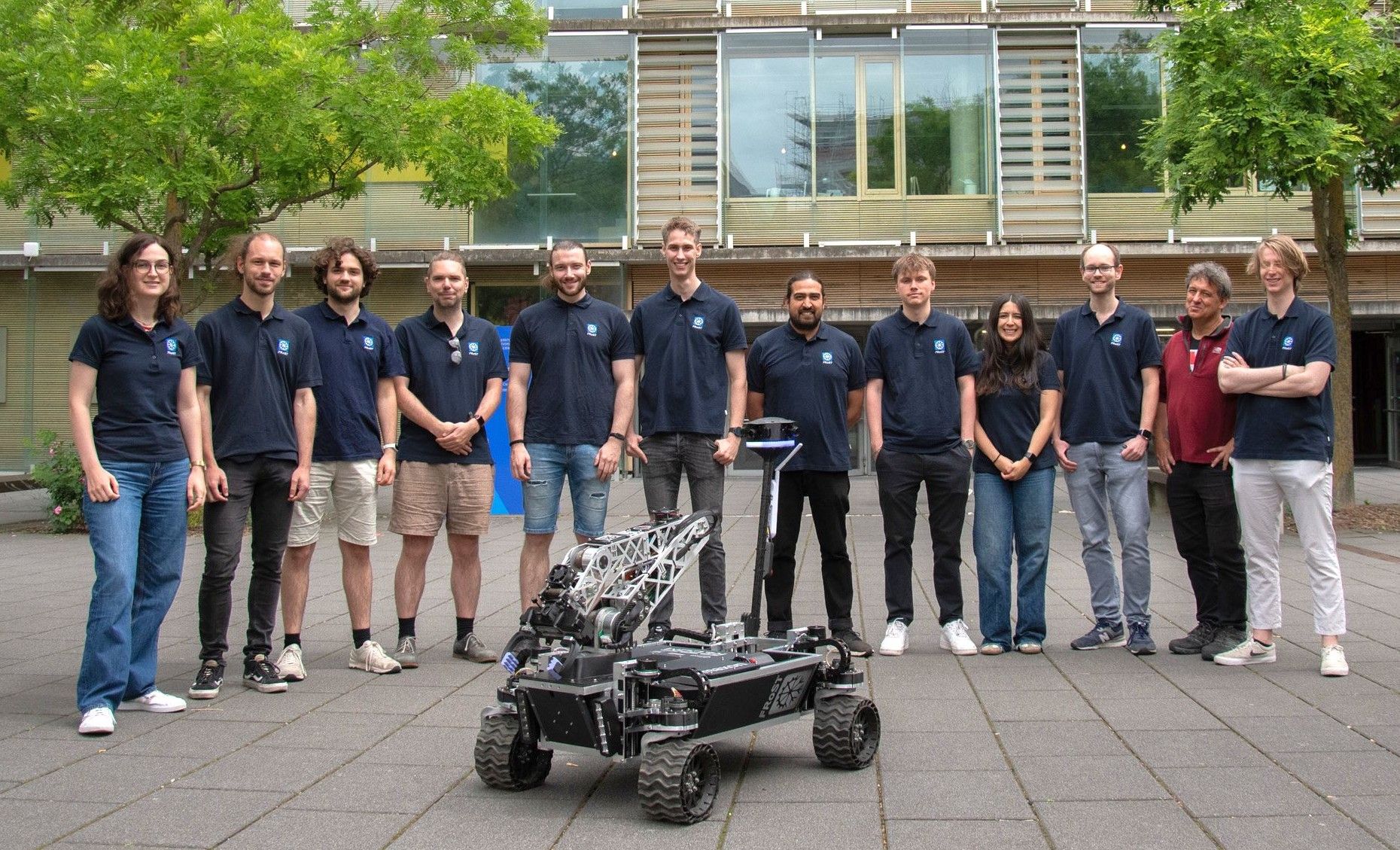
Fielding their self-built rover, the Frankfurt Robotics Science Team (FRoST) will take on the competition in Poland from 4 to 6 September 2026. 124 university teams from 29 countries applied for the international space and robotics event organised by the European Space Foundation. FRoST placed 9th in qualification, securing one of the 25 spots in the on-site starting field in Krakow — its sixth ERC appearance — and lines up with a partly new roster, including women on the team for the first time, and a new rover: EROS.
A New Chassis for Better Terrain Capability
The name isn’t a nod to a Greek deity — it’s an acronym. EROS stands for Extreme Research and Observation System. “The biggest change compared to last year is our rover’s chassis,” explains team lead Jeldrik Schröer. “With EROS, we’ve moved away from the tracked chassis that carried FRoST through several rover generations since the team’s earliest days.” The new chassis has four wheels that can each be driven and steered independently.
This gives EROS better terrain capability and more precise driving manoeuvres. “The wheels also allow for height adjustment, so the rover can adapt to the terrain,” Schröer adds. While central components such as the robotic arm and drill unit were carried over from the predecessor model ARES and further improved, new electronics and software enable autonomous navigation and robotic-arm manipulation for the first time.
At ERC 2026, EROS will be joined in the field by FRoST’s aerial platform, DAEDALUS: a drone performing autonomous missions at the competition.
Volcanoes, craters, dry riverbeds: teams and their rover prototypes must complete demanding tasks in a geologically realistic Mars terrain, modelled on real NASA and ESA missions. These include navigating the Marsyard, collecting soil samples, performing maintenance and repairs with the robotic arm, analysing samples, and presenting the project to a jury. Terrain capability is a decisive factor throughout.
A Mix of Engineering Creativity and Innovation
FRoST has existed with a rotating roster of members since 2018 and was founded by Prof. Dr. Karsten Schmidt, head of the Mechatronics and Robotics master’s programme. Students from various degree programmes work together in the team to develop creative technical solutions in robotics. Two female team members are studying the Mechatronics and Robotics (MeRo) master’s programme, while a third is studying Mechatronics at bachelor’s level. “Since late 2025, FRoST has seen substantial growth in bachelor’s students — ten from the Mechatronics programme alone, plus one more from the Electrical Engineering bachelor’s programme,” says Schröer. Together with the five Mechatronics and Robotics master’s students, FRoST now has an ideal mix.
Skills for the Start of a Career
“Qualifying for the ERC time and again shows that knowledge transfer between generations of FRoST members, and across the different degree programmes, works smoothly,” says Prof. Dr. Karsten Schmidt. “But the project isn’t just a chance for our students to demonstrate their skills and creativity on a global stage. It also gives them competencies and skills that make it easier to start their careers afterwards.”